The Effects of Hot Spots Policing on Crime an Updated Systematic Review and Meta-analysis
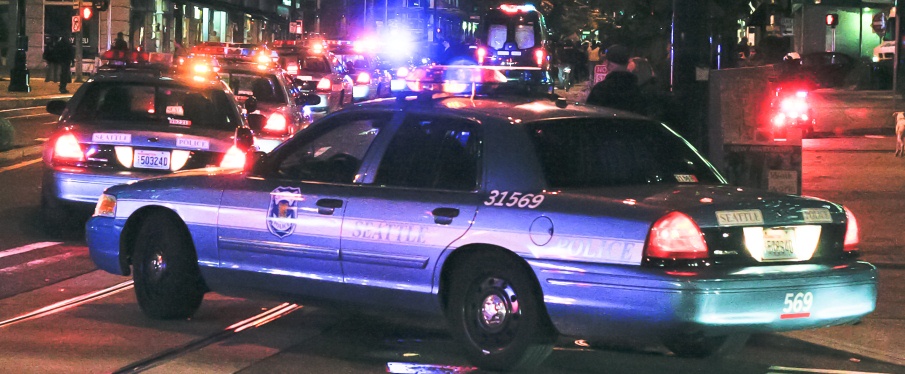
Seattle Police motorcar image courtesy of Flickr user evilpeacock and used under a Artistic Eatables license.
What is Hot Spots Policing?
Over the by two decades, a series of rigorous evaluations have suggested that constabulary tin can be effective in addressing criminal offence and disorder when they focus in on small-scale units of geography with loftier rates of crime. These areas are typically referred to as hot spots and policing strategies and tactics focused on these areas are usually referred to as hot spots policing or place-based policing.
This place-based focus stands in contrast to traditional notions of policing and crime prevention more generally, which have oft focused primarily on people. Police, of course, have never ignored geography entirely. Police beats, precincts, and districts determine the allocation of police resources and dictate how police respond to calls and patrol the city. With identify-based policing, nevertheless, the concern is with much smaller units of geography than the constabulary have typically focused upon. Places here refer to specific locations within the larger social environments of communities and neighborhoods, such as addresses, street blocks, or small clusters of addresses or street blocks. Crime prevention effectiveness is maximized when police focus their resources on these micro-units of geography.
Hot spots policing covers a range of law responses that all share in mutual a focus of resource on the locations where crime is highly full-bodied. Merely as the definition of hot spots varies across studies and contexts (from addresses to street segments to clusters of street segments), and so practice the specific tactics police employ to address loftier crime places. There is non one way to implement hot spots policing. The approaches can range rather dramatically across interventions.
For example, the strategies of identify-based policing can be as simple as drastically increasing officeholder time spent at hot spots, equally was the example in the Minneapolis, MN Hot Spots Patrol Experiment. But place-based policing can as well have a much more complex approach to the amelioration of crime issues. In the Jersey City, NJ Drug Market place Analysis Program Experiment, for example, a iii-stride program (including identifying and analyzing issues, developing tailored responses, and maintaining crime control gains) was used to reduce problems at drug hot spots. Also in Bailiwick of jersey City, a problem-oriented policing (Popular) approach was taken in developing a specific strategy for each of the pocket-size areas defined every bit violent criminal offense hot spots.
We note that predictive policing shares in common a focus on place-based prevention efforts, although the focus is more on predicting where criminal offence is likely to occur in the time to come rather than responding to by/ongoing criminal offence concentrations. There is at present one predictive policing study in the Matrix that uses a micro place unit of assay (Mohler et al., 2015). There is one other predictive policing report in the Matrix (Hunt et al., 2014) that used a larger geographic unit of analysis (i.east. the police force district), finding no impact of predictive enforcement on holding law-breaking.
What is the Testify on Hot Spots Policing?
Hot spots policing is listed under "What works?" on ourReview of the Research Evidence.
The evidence base for hot spots policing is specially stiff. Every bit the National Inquiry Council (2004: 250) review of police effectiveness noted, "studies that focused police resources on crime hot spots provided the strongest commonage evidence of police force effectiveness that is now available." A Campbell systematic review by Braga et al. (2012) comes to a similar conclusion; although not every hot spots written report has shown statistically significant findings, the vast majority of such studies have (20 of 25 tests from xix experimental or quasi-experimental evaluations reported noteworthy law-breaking or disorder reductions), suggesting that when police force focus in on crime hot spots, they can have a significant benign impact on crime in these areas. As Braga (2007: 18) concluded, "extant evaluation enquiry seems to provide fairly robust evidence that hot spots policing is an effective criminal offense prevention strategy."
In Braga and colleagues' meta-assay of experimental and quasi-experimental studies, they found an overall significant average effect of hot spots policing, suggesting a meaningful benefit of the hot spots arroyo in handling areas compared to command areas. Importantly, at that place was little evidence to suggest that spatial deportation was a major concern in hot spots interventions. Offense did not just shift from hot spots to nearby areas.
What Should Police Be Doing at Offense Hot Spots?
one. The Minneapolis Hot Spots Patrol Experiment suggested that increased police presence alone leads to some law-breaking and disorder reduction. Officers were non given specific instructions on what activities to engage in while in hot spots. They just were told to increment patrol time in the handling hot spots.
Koper (1995) found that each additional minute of time officers spent in a hot spot increased the corporeality of time later officers departed before hell-raising activeness occurred until a plateau was reached. The ideal fourth dimension spent in the hot spot was fourteen to 15 minutes. The best arroyo for saturation patrol is for police to travel betwixt hot spots, spending almost xv minutes in each hot spot, and moving from hot spot to hot spot in an unpredictable club, so that potential offenders recognize a greater price of offending in these areas because police enforcement could increase at whatever moment. These recommendations were practical to a hot spots experiment in Sacramento, where handling hot spots received 15 minute visits from patrol visits approximately every 2 hours. The intervention was associated with declines in calls and serious incidents.
2.The Braga and Bond (2008) hot spots experiment in Lowell, Massachusetts assessed which hot spots strategies were near effective in reducing crime. Results suggested that situational prevention strategies had the strongest impact on crime and disorder. Such strategies focus on efforts to disrupt situational dynamics that allow criminal offense to occur by, for example, increasing risks or effort for offenders or reducing the bewitchery of potential targets. Such approaches include things similar razing abased buildings and cleaning up graffiti. Increases in misdemeanor arrests made some contribution to the crime control gains in the handling hot spots, but were not as influential as the situational efforts. Social service interventions did not have a significant bear upon.
three. An additional promising arroyo for dealing with crime hot spots is having officers contain principles from problem-oriented policing (POP). A recent experiment in Jacksonville, FL was the first study to compare different hot spot treatments in the aforementioned study with one treatment group receiving a more standard saturation patrol response and the second receiving a trouble-oriented response that focused on officers analyzing bug in the hot spot and responding with a more than tailored solution. Results showed a decrease in crime (though not a statistically pregnant decrease) in the saturation patrol hot spots, just this decrease lasted only during the 90 day intervention period. In the POP hot spots, in that location was no pregnant crime decline during the intervention menstruation, but in the 90 days after the experiment, street violence declined by a statistically significant 33 percentage. Problem solving approaches may accept more time to show beneficial results, simply any successes that come up from a problem-oriented framework may exist more long-lasting in nature. Braga and colleagues (2012) conclude in their systematic review that problem solving versus a focus on just increasing enforcement may bring well-nigh longer-term crime control gains. Equally they note, "While arresting offenders remains a fundamental strategy of the police and a necessary component of the police response to crime hot spots, information technology seems likely that altering place characteristics and dynamics will produce larger and longer-term crime prevention benefits" (Braga et al., 2012: 32).
sullivanlifecyll92.blogspot.com
Source: https://cebcp.org/evidence-based-policing/what-works-in-policing/research-evidence-review/hot-spots-policing/
0 Response to "The Effects of Hot Spots Policing on Crime an Updated Systematic Review and Meta-analysis"
Post a Comment